
West Virginia's Recent Arrest Landscape
West Virginia has no single statewide arrest roster. The Division of Corrections and Rehabilitation (WVDCR) runs ten regional jails instead. All 55 counties fall inside that network. Each arresting agency keeps its own incident and report records. A person might be cited and released. Others are booked into a regional jail, or transferred somewhere else later on. A custody entry is not a full arrest history. Always check the source and its update time before treating an entry as current.
The regional setup is the best statewide entry point. WVDCR explains the shift from county jails to regional facilities on its history page. County assignment matters here. Someone held in one regional jail may have been arrested in a different county entirely. The statewide directory routes searches by arrest location. It points toward each county's local records, feeds, and contacts. It does not promise a live feed or public photos at every local site.
The WVDCR offender-search page links to four separate tools. There are searches for jail custody, daily admissions, prisons, and the Escapees and Absconders list. Each serves a different stage of a record. Match the tool to the question. A new admission calls for one search. Current jail custody, state-prison time, and a supervision list each call for a different one.
The WVDCR FY2025 report lists the average custody population. That figure covers people held, not the volume of arrests in a year.
Where County Records Appear
County practices vary across West Virginia. Some offices link to a vendor roster or a booking view. Others just point to WVDCR. A few have no stable public feed at all. A local roster often lists people still in custody rather than everyone arrested there. Its photo field can sit empty. That can happen even when an intake image exists in the agency's system. A missing name or photo proves nothing about whether an arrest occurred.
The WVDCR jail offender search is a statewide custody lookup. County sheriffs and police departments hold the incident reports from their own work. The regional jail record can locate current custody. It cannot replace the original agency file. Use the West Virginia County Directory to pick the right county site. Its local entry points follow from there. This county-by-county split is exactly why a single statewide count or photo list would mislead.
- Start with the county where the arrest took place and note the approximate date.
- Check WVDCR Daily Incarcerations for a recent admission, then use the jail offender search for a current custody profile.
- Open that county's local site to see whether its sheriff or police source publishes a roster or photo.
- If no public entry answers the question, ask the arresting agency or custodian for the existing record.
The Barbour County vendor roster shows what a local page can offer. It carries booking number, date and time, charge, and photo fields. One county's format is not a statewide standard, though. Many county files point to the regional system instead. Some name no stable public roster at all. That makes the county site's own date and source label as important as the entry itself.
Does a blank result mean no arrest? No. The person may have been released, cited, booked under another spelling, or entered later in a different system. Some records lawfully stay confidential as well. A blank is a starting point, not an answer.
Note: A missing result can reflect a release, entry delay, a different spelling, or a record that lawfully remains confidential.
Find a West Virginia Arrest Today
For a new event, identify the county and the arresting agency first. WVDCR's Daily Incarcerations search gives a date-oriented view of jail admissions. It is not a rolling 24-hour arrest list. County vendor pages may use their own date window. Their update rhythm may differ as well. A fresh arrest can take time to appear. Booking details must be entered and checked first. Someone released on citation may never appear as a jail admission at all.
| Window or question | Official starting point | Route |
|---|---|---|
| Same-day jail admission | WVDCR Daily Incarcerations, a date-oriented admissions view | 24 Hour Arrests |
| Multi-day agency or news log | WVSP News, local agency notices, and dated news archives | Arrest Log |
| One person's custody status | WVDCR jail offender search or VINELink for covered custody | VINELink Check |
| Local roster or report | Arresting county sheriff or police records custodian | County Directory |
Same-day statewide coverage lives on the 24 Hour Arrests page. The multi-day view sits on the Arrest Log. Selected agency releases and secondary archive limits are covered there too. For release or transfer alerts on one person, try the VINELink Check. These sources answer different questions. Compare custody time, source date, and county instead of expecting identical lists everywhere.
West Virginia VINE links custody checks and alerts to the adult DCR regional-jail system. A movement can take time to register. The service does not cover BOP or ICE custody. It cannot show a final court result either. Use it to follow one person's custody status. When the question is a fresh booking or a case outcome, contact the jail or court directly.
West Virginia Record Sources
Start with official sources, since each one identifies the record holder and what the record actually documents. A custody search tells you jail status. An agency release describes an investigation or enforcement action, while a court portal tracks case activity. None of them is a full statewide arrest feed. News outlets add reporting and context, yet they pick which events to cover. Commercial aggregators copy or organize records under their own policies, so their listings can lag, omit a later case update, or show a booking photo with no current custody record behind it.
| Source | Record role | Status |
|---|---|---|
| WVDCR Daily Incarcerations | Date-oriented jail admissions | Official custody source |
| WVSP News | Selected State Police releases | Official, episodic |
| Judiciary record access | Magistrate and circuit case activity | Official court source |
| WV MetroNews | Selected statewide news reports | News, not a roster |
| RecentlyBooked West Virginia | Publisher's recent-window pages | Secondary, not a custodian |
| Mugshots.com West Virginia | Historical publisher pages | Secondary, not official |
| Arrests.org West Virginia | Publisher's state and county pages | Secondary, may be limited |
WV MetroNews' statewide news archive shows the event-driven nature of reporting.
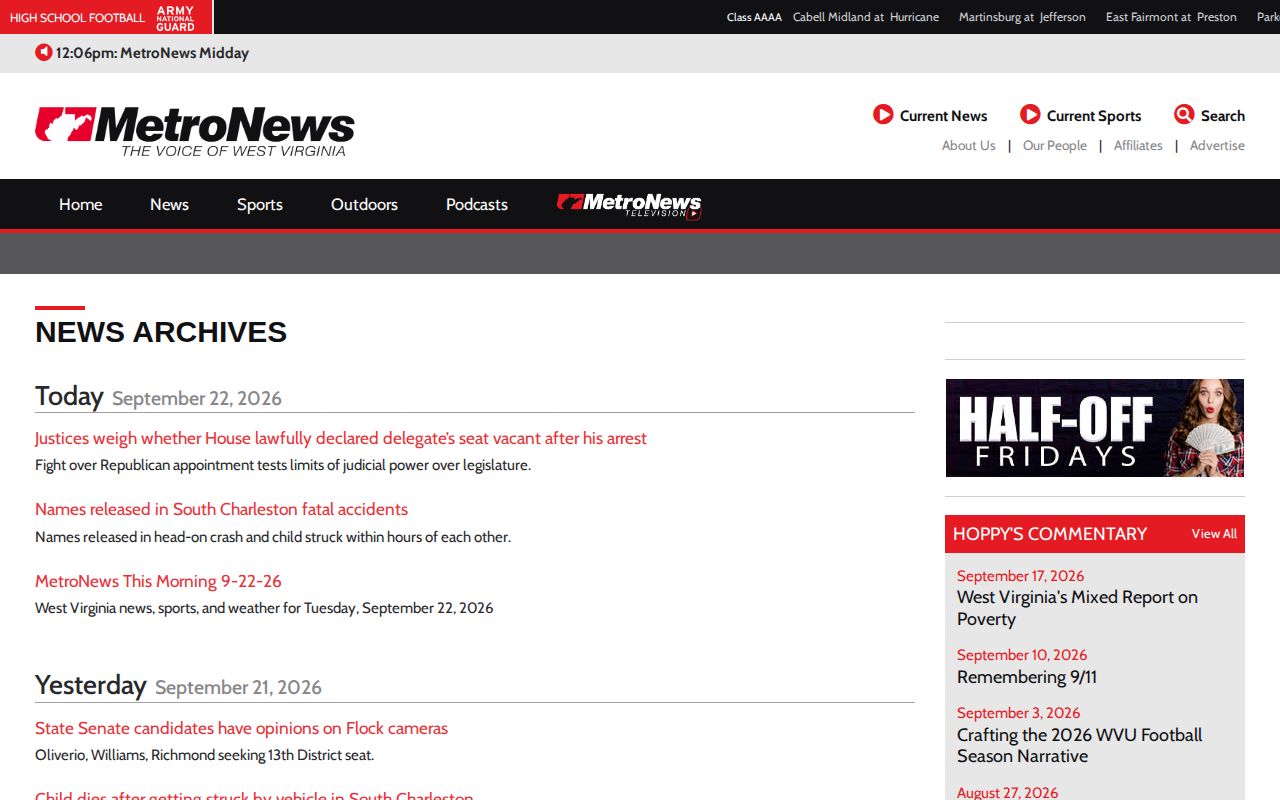
A news story may surface facts that came out later. It still cannot replace the booking record or the court's own file.
The statewide Busted Newspaper section is another secondary archive. It lists no free statewide removal route. Mugshots.zone offers no current West Virginia section. So no generic search page is listed here for it. Every publisher's dates, disclaimers, and correction policies are that publisher's own claims. They are not state policy.
Note: Read a secondary entry as the publisher's copy. Then confirm the same event with the official record custodian.
West Virginia Booking Photos
A booking photo is taken during custody processing. Whether it appears publicly depends on the agency and the system. WVDCR's admission procedure calls for three intake photographs in its jail records; a public search result may show only one, and only when available. Some county vendor rosters include a photo field. Many county sources offer no stable public photo roster at all. Just because a photo sits in an internal system does not mean an agency may post it routinely on social media.
West Virginia Code §62-1-6a bars law-enforcement social-media sharing of booking photos for a defined "minor offense." The restriction has exceptions for conviction, fugitive or imminent-threat situations, and court orders. WVDCR is expressly excluded from the statute's definition of a law-enforcement agency. That carve-out separates jail custody searches from agency social-media publication. For the statute and correction routes in more depth, see Are Arrest Records Public?
RecentlyBooked's removal policy describes that publisher's own no-charge review route for qualifying cases.
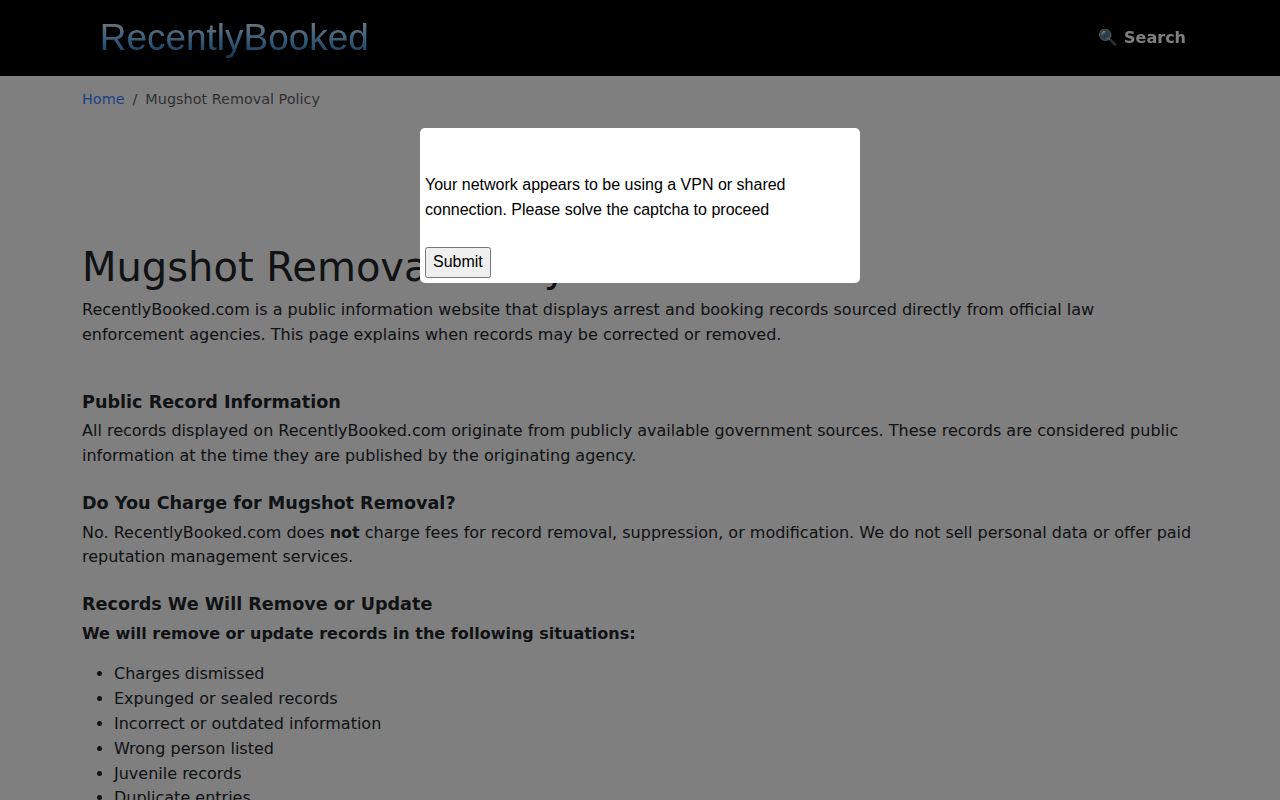
That policy is the publisher's own description and may change. It is not a West Virginia legal right.
Mugshots.com's record-maintenance policy lays out yet another publisher's stated correction process.
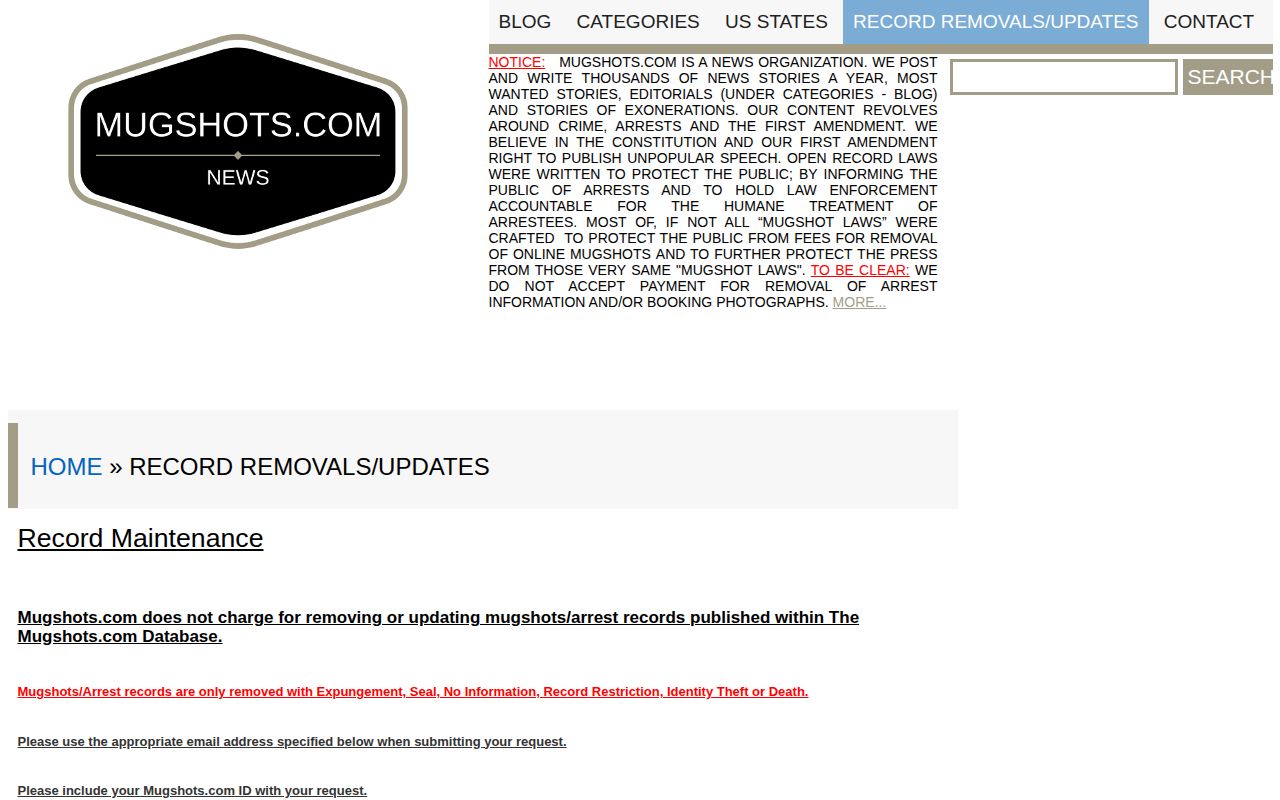
A favorable update is not the same as deletion. One publisher's policy never governs other copies or search results.
Fields in a West Virginia Booking Record
A booking record is an administrative snapshot, not a full case file. The State Archives' sheriff retention schedule describes a Prisoners Report containing the fields below. A regional-jail public profile may expose a different subset. The arresting agency may keep a separate incident report too. Ask each custodian for the exact record and period you need. The systems do not share one form.
| Field | What it records |
|---|---|
| Name and physical descriptors | Identity fields recorded by the jail, subject to correction and privacy limits |
| Offense charged | The charge listed at booking |
| Charging party or process | The person or legal process that led to commitment |
| Commitment and release dates | When jail custody began and ended in that record series |
| Fines, costs, and days | Items the schedule says may be tracked in a Prisoners Report |
| Booking or intake photo | May be held separately and may not appear in the public view |
| WVDCR custody profile | May show person, facility or location, booking/admission details, photo when available, and more-info fields |
- Booking
- The intake record made when a person enters custody after an arrest.
- Arraignment
- A court hearing where a charge is addressed and the case moves forward.
- Bond
- A court-set condition that can allow release while a case is pending.
- Disposition
- The court's result, such as dismissal, plea, or verdict.
- Expungement
- A court-ordered process that seals or removes the records covered by a statute or order.
A person just booked may appear in the DCR admissions view once intake is entered. Someone released or transferred can drop off a current roster. The booking record stays alive under its retention rule. A court disposition is a separate record. Check it on the docket.
The sheriff retention schedule lists the record fields and retention instructions used for this inventory. It covers recordkeeping, not a promise that every field or image appears online.
What does a court record add? Later filings and case outcomes. Use the case number or name. See whether a charge was changed, dismissed, or resolved.
Note: A booking photo may sit under a separate record series, so request it by name and ask which schedule applies.
Request West Virginia Arrest Records
West Virginia Code §29B-1-3 gives every person the right to request a public record from its custodian. The right is subject to the exemptions in §29B-1-4. Name the record with reasonable detail. A written response is due within five days, excluding Saturdays, Sundays, and legal holidays. In that window the custodian must provide the record, state when and where it can be inspected, or issue a written denial. That deadline triggers a response, not full release of every investigation file. A public body may charge actual reproduction cost. But it cannot charge a search, retrieval, or staff-time fee just for finding responsive records.
- Identify the arresting sheriff, police department, or State Police detachment and the regional jail, if custody is the question.
- Give the county, approximate date, known report or booking number, and exact record sought, such as the incident report or booking photograph.
- Ask for electronic copies and cite West Virginia Code §29B-1-3. Keep the request focused on existing records.
- Ask the custodian to identify the legal basis for any redaction or denial and to state any reproduction charge.
- For an arrest by WVSP, use its official report request or FOIA route; for WVDCR-held custody records, use the official WVDCR contact route to identify the custodian.
Section 29B-1-3 sets out the response framework and cost rule. Section 29B-1-4 lists exemptions for privacy, investigative, juvenile, and other protected material.
For records held by a county office, the county directory helps pinpoint the right local route. For State Police reports and fees, the WVSP Arrests page explains Form 141. It also covers the separate FOIA path.
West Virginia Mugshot and Arrest Rules
Booking photos get special treatment in West Virginia law. Under West Virginia Code §62-1-6a, enacted in 2023, agencies face limits on posting mugshots to social media for a "minor offense." That term reaches certain misdemeanors plus expungement-eligible nonviolent felonies, with exclusions. Sharing is still allowed after a conviction. It is allowed too when a person is a fugitive, poses an imminent public-safety threat, or when a court orders release for a legitimate public interest. The law also forces takedowns. If an agency posted a booking photo of a suspect, it must remove the image within 14 days of a qualifying request. Qualifying events include dismissal, no indictment, acquittal, or a conviction later reversed, vacated, or nullified. The SB 558 history documents the 2023 enactment.
That removal clause is narrow. It binds the agency that shared the photo, not every private copy or search result, and it is no general right to erase an old arrest. West Virginia has enacted no statewide ban on commercial publishers charging for mugshot removal. The nearest attempt was 2024 House Bill 4621. It never became law. Expungement works through the courts instead. §61-11-25 covers acquittals and dismissals, while §61-11-26 sets conditions for eligible convictions. The first can reach arrest records, fingerprints, photographs, and electronic data. Eligibility turns on the case and the statute. The state law guide walks through the rules and forms in depth.
Timing matters here. For an eligible acquittal or dismissal under §61-11-25, a petition generally waits at least 60 days after the case outcome. A granted order directs agencies to seal or expunge covered records. Agencies then certify completion within 60 days. Eligible convictions follow different conditions under §61-11-26. These are court processes tied to one case, not an automatic wipe of every independent copy online.
Juvenile files are different. West Virginia keeps them confidential under Chapter 49, including §49-5-101. A narrow statutory exception does not turn ordinary juvenile booking material into a public adult roster. Denied a public-record request? §29B-1-5 allows circuit-court review, and the public body must justify its denial. Keep perspective on missing results. A denial or an empty search does not prove an arrest never happened.
West Virginia Code §61-11-25 defines the expungement route for eligible acquittals and dismissals. Covered agencies must follow a granted order, though a separate online republication may need its own correction request.
West Virginia Arrest Warrants
No single public database covers every West Virginia warrant. Instead, several official layers exist. The WVSP Most Wanted page posts State Police fugitive lists, including cold-case and Eastern Panhandle entries. It is selective rather than complete. WVDCR's Escapees and Absconders search covers people tied to DOC custody or supervision, not every local arrest warrant.
The U.S. Marshals Service adds a federal layer. Its Southern District of West Virginia page profiles fugitives, lists task-force details, and accepts tips. County sheriff wanted pages are hit or miss. To check a suspected warrant, contact the court, clerk, or law-enforcement agency through an official channel and confirm the record directly. A third-party face page is never proof that a warrant is still active. WVSP's official wanted page shows the agency's own list and how it frames tips.
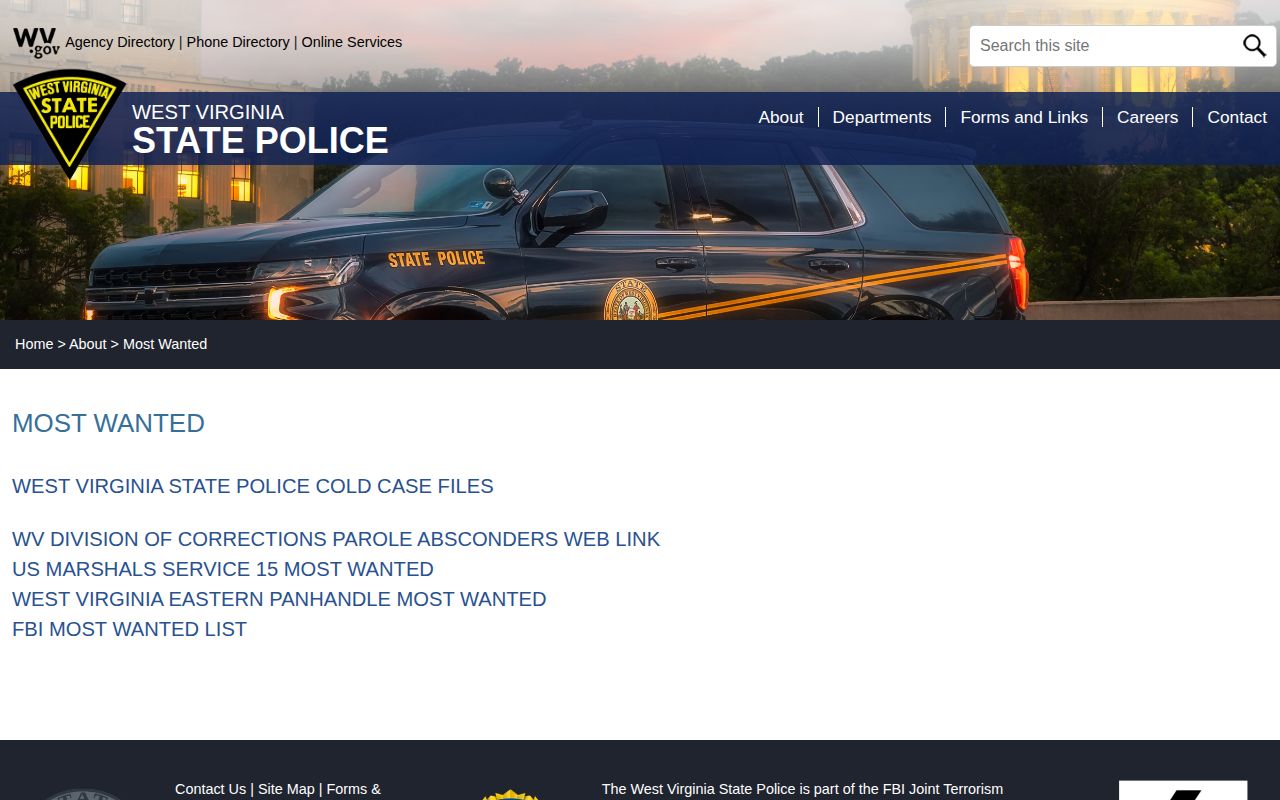
Follow the agency's safety notice and never approach anyone shown on a wanted page. WVDCR's Escapees and Absconders search is a separate custody and supervision list.
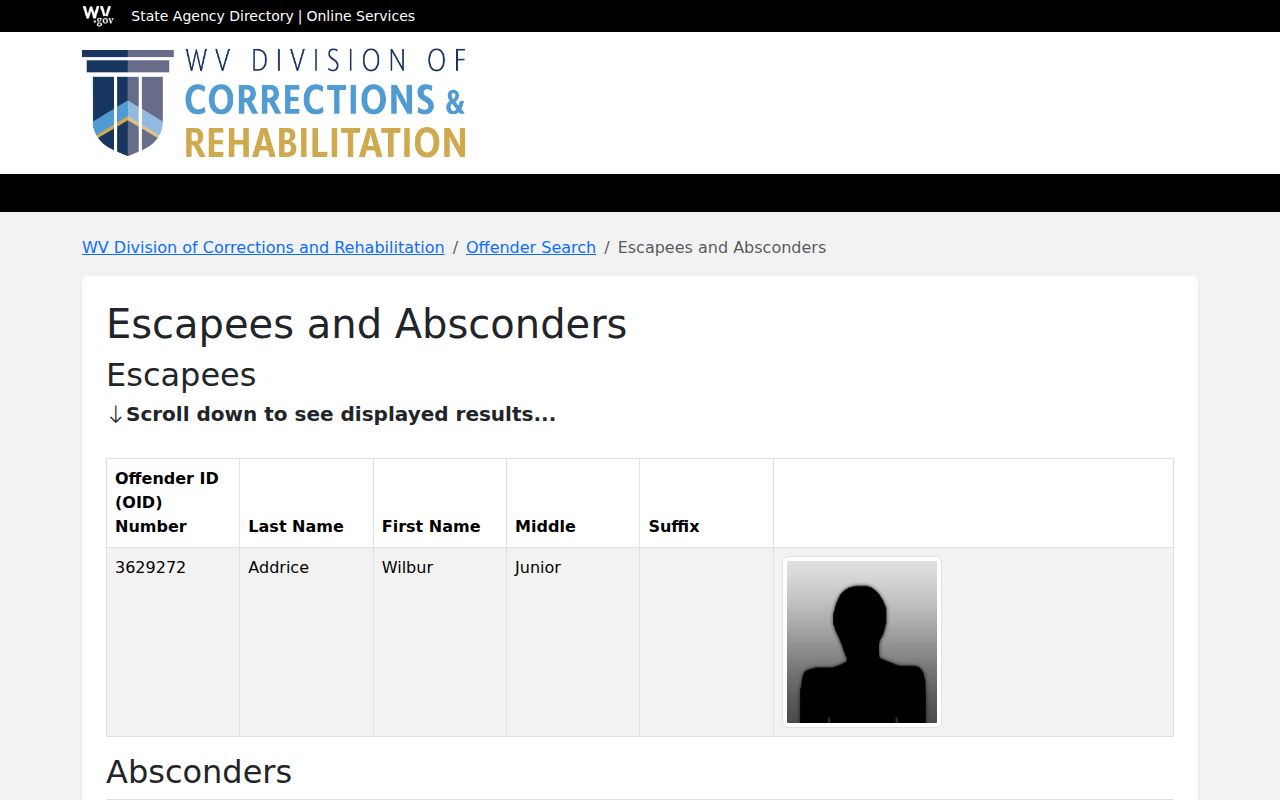
For immediate danger, call 911. For information, use the official agency tip route instead of contacting the person. The Marshals' West Virginia district pages add a federal layer with Mountain State Fugitive Task Force notices. Local sheriff wanted pages stay uneven. Verify any suspected warrant with the court or the arresting agency. No public statewide warrant search exists. Never follow the person, send messages, or intervene yourself. Note: A wanted-list entry is a lead from its publishing agency, not a current warrant check or court disposition.
After a West Virginia Arrest
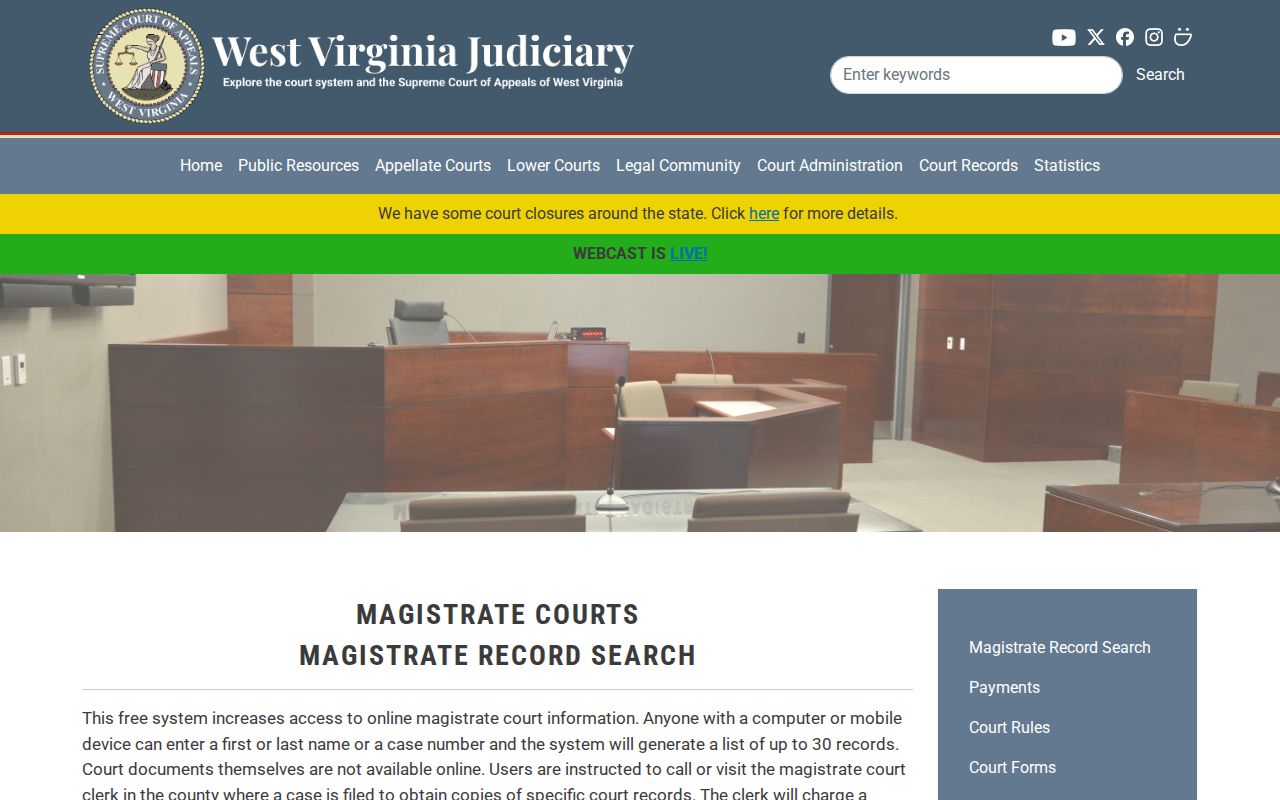
A booking charge only opens the case. Hearings, pleas, dismissals, and sentences show up later in the court file. The West Virginia Judiciary's record-access page covers circuit and magistrate records in all 55 counties. The free Magistrate Record Search works by name or case number and caps a public result set at 30 records. Results can list case dates, charges, disposition, and document listings, though the underlying document may still require a clerk visit or a copy request. Circuit records run through WVPASS, with access limits on sealed and juvenile matters. The Judiciary's statewide court access page describes what each county makes available.
Don't treat a roster charge as the final word. Check case activity through a court source such as the magistrate search page, which explains the name and case-number lookup.
State prison custody is a different stage entirely. WVDCR's prison search starts after admission to state custody. BOP and ICE run separate federal and immigration locators. The BOP locator offers no mugshot photographs, a court search cannot replace a booking lookup, and a custody search settles nothing about the case.
Old West Virginia Custody Records
Records age out of public views for different reasons. A person may be released, a vendor may shorten its window, or an agency may retain a record under a schedule that is separate from web publication. The State Archives' sheriff schedule lists a five-year period for commitment records, five years after the audit for jail boarding reports, and a ten-year-or-audit instruction for a Prisoners Report. Fingerprint records have a different rule. These periods describe specific record series; they do not establish how long a booking photo remains online or prove that a missing item was never made.
The State Archives corrections collections describe historical prison and reform-school records, with privacy restrictions. They are not a digitized statewide mugshot database.
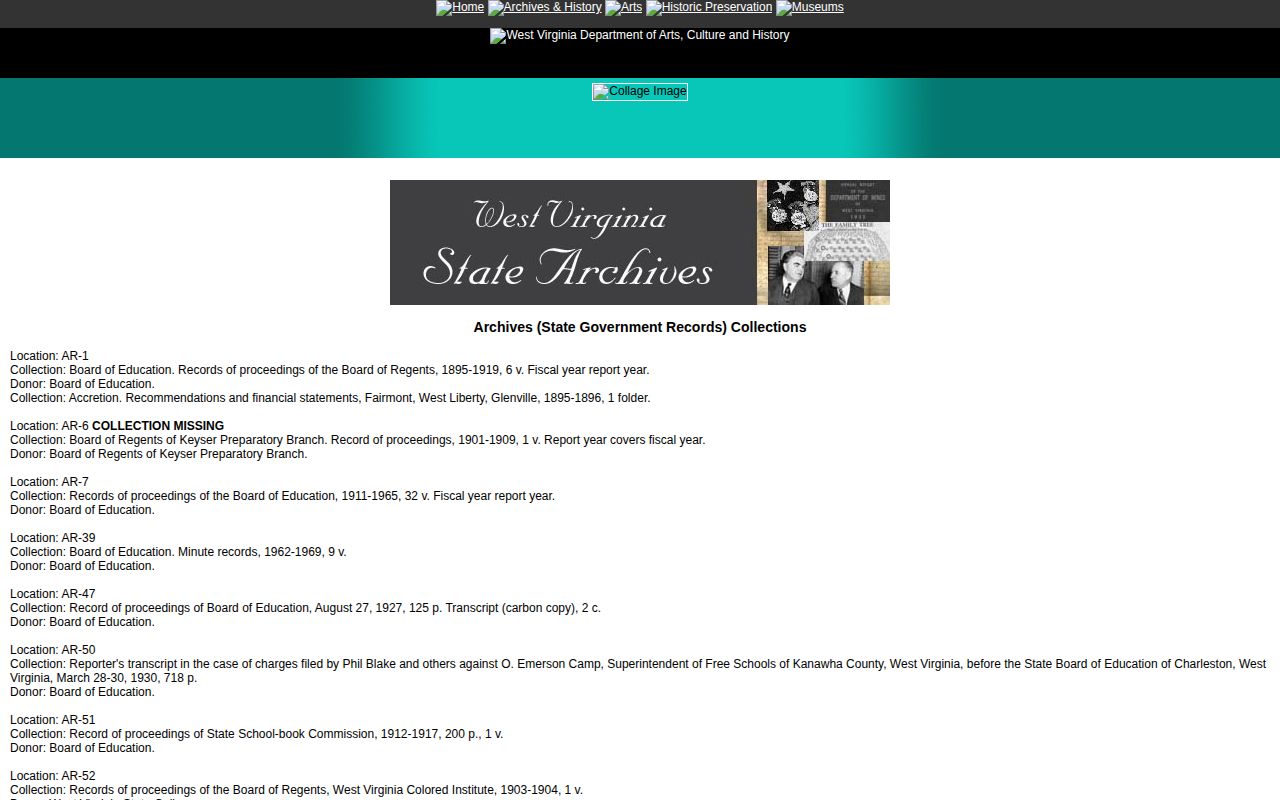
The Archives handles older requests best when you name the institution, the series, and the years you want, then follow its access process. Commercial publishers play by different rules. RecentlyBooked offers a free route for certain entries. That covers dismissal, expungement, wrong person, juvenile, duplicate, and outdated items. Mugshots.com calls its record-maintenance process free for stated grounds. It may update a page rather than delete it. Busted Newspaper lists no statewide free opt-out for West Virginia. Arrests.org shows no stable procedure here either. Publisher statements are not a legal remedy, though. Skip any paid service promising universal erasure. Rely instead on a court order, the original custodian, the publisher, and the search engine's own correction route as each applies.