
Are West Virginia Arrest Records Public?
Often yes, though not as a blanket rule. West Virginia's public-records law covers many public records. It gives people a right to inspect and copy records kept by public bodies. Exceptions protect privacy, juvenile files, investigative material, and other listed information. An agency might post some adult booking details online. It might answer a written request instead. Or it might withhold and redact parts the law protects. Who holds the record matters as much as the arrest itself.
A booking entry is an administrative custody event. It shows a person was taken into custody. The booking photo can fall under a separate publication rule. A court order can later change what an agency keeps or discloses. For current status, check the government source that created the record. Compare it with the court file when one exists.
West Virginia's public-records law sets the general access rule. Neighboring sections carve out exceptions and add a court remedy. It offers a path to request a public record. No law forces every record online, and protected details stay protected.
West Virginia Arrest Photo Rule
West Virginia Code §62-1-6a restricts when a law-enforcement agency may post a booking photo on social media after a "minor offense." The statute defines that photo as a still image made by law enforcement during an arrest or lawful custody. Its agency definition covers state, county, and municipal organizations that enforce criminal laws. WVDCR and its subordinate organizations are expressly excluded. Don't confuse the social-media limit with the separate corrections custody search.
"Minor offense" is a statutory term. It covers misdemeanors and certain nonviolent felonies eligible for expungement under §61-11-26(a), subject to that statute's exclusions. It also names specific motor-vehicle offenses. So the limit reaches beyond low-level misdemeanors. The current section controls the definitions and exceptions.
Read the enacted text of §62-1-6a itself. A social-media post is not the authority. Neither is a secondary photo page.
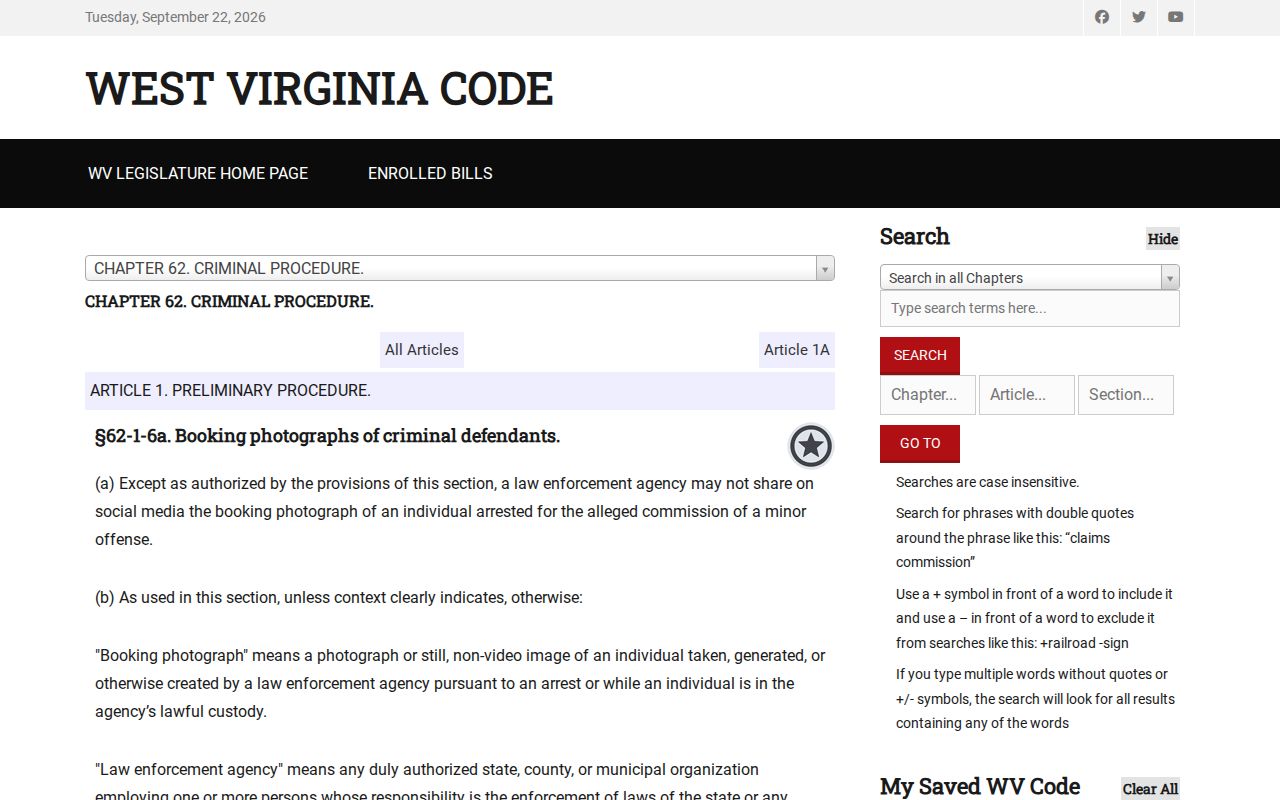
The rule only governs agency sharing on social media. It is not a ban on arrest records or on independent republication.
West Virginia Arrest Photo Exceptions
Section 62-1-6a has exceptions. An agency may share the booking image if the person has been convicted based on the conduct; if the agency determines that the person is a fugitive or poses an imminent public-safety threat and publication may help locate or apprehend the person or reduce the threat; or if a court orders release for a legitimate public interest. A good-faith agency error is also addressed in the statute. These are defined exceptions, not permission to post every booking photo as a routine feed.
The Legislature enacted the measure as 2023 Senate Bill 558. The official SB558 history records its passage and signature in 2023; the enrolled law took effect that summer. No published appellate or reported federal decision specifically interpreting §62-1-6a was located in the reviewed material as of September 22, 2026. That is a research finding, not a claim that no dispute has ever arisen.
In 2024, House Bill 4621 proposed broader rules, including restrictions on commercial “remove-for-pay” publications. Its official bill history shows referral to Senate Judiciary and no enactment in the history reviewed. The proposal is not current law. The distinction is important: the enacted agency photo rule cannot be described as a statewide command that every private publisher remove a photo for free.
The reviewed sources show no enacted statewide law that broadly bars a private publisher from charging to remove an otherwise lawful image or requires every publisher to offer a free opt-out. The proposal did not change that result.
Note: The proposal was not enacted in the history reviewed, so it does not expand the rights created by the current agency-photo statute.
West Virginia Arrest Photo Removal
The same section gives agencies a real removal duty. When an agency shared the booking photo of a person suspected of a crime, it must take the image down within 14 days after the person or an authorized representative asks. The request qualifies when the charge was dismissed. It qualifies when a grand jury returned no indictment or after an acquittal. It qualifies when a court reversed, vacated, or nullified the conviction. The requester should identify the agency's post and supply reliable proof of the qualifying outcome. Keep copies of everything.
This deadline is not a blanket rule. It reaches no old image you simply dislike. The text does not order a private site, news outlet, social-media user, or search engine to remove an independent copy. It sets no separate monetary penalty either. Send the request to the publishing agency. When copies appear on more than one source, trace each to its publisher. An agency controls its own post, a private publisher follows its own stated policy, and a search engine can keep a result after the source page changes. No agency request guarantees every copy will vanish.
How West Virginia Record Requests Work
Requests start with the custodian. Under §29B-1-3, the requester describes the record with reasonable specificity. The custodian then gets five days, not counting Saturdays, Sundays, and legal holidays. In that window it must provide the record or state when and where it can be inspected. It can also issue a written denial. Electronic copies can be requested. For copies, the public body may charge its actual reproduction cost. No fee covers search, retrieval, or staff time. That includes time spent locating the record. Exempt material may still be redacted or withheld.
The Legislature's page for §29B-1-3 displays the response and cost rule. Be specific enough for the custodian to identify the record. No form is required that the law does not demand.
- Send the request to the agency that created or holds the record, such as the arresting police agency, sheriff, jail custodian, or court clerk.
- Give the county, approximate date, person or incident reference, and a clear description of the report, booking record, or photograph sought.
- Ask for an electronic copy when useful, and ask the custodian to identify the legal basis for any redaction or denial.
- Keep the response and any copy-cost estimate. If access is denied, review the stated exemption and the statutory court remedy.
Not everything is open. Exemptions under §29B-1-4 include personal privacy and law-enforcement investigative material. Medical or confidential information is covered too. So are juvenile records and other protected categories. Photographs can still count as public records when created or received in public business. But that label never overrides a valid privacy or investigative exception.
A denial is not the end. §29B-1-5 lets the requester take the dispute to circuit court. That county is where the record is kept. The case is heard anew. The public body carries the burden of supporting its denial. Filing does not imply the agency acted improperly.
Note: A five-day response period is not the same as a promise that a record will be posted online at once.
West Virginia Juvenile Record Limits
Juvenile files take a different path from adult booking records. Section 49-5-101 keeps information about a child confidential. Courts, law-enforcement agencies, WVDCR, and other covered bodies all fall under that rule. Disclosure happens only where the chapter or a court permits it. One narrow provision allows public identity. It applies to a child adjudicated or convicted of a violent or felonious crime. Ordinary juvenile booking material stays closed. The official text of §49-5-101 sets the baseline and its listed exceptions.
A name or a picture alone proves nothing about age. Later handling stays restricted as well. The statutory period runs past the 18th birthday. It may also run to the end of juvenile jurisdiction. After that point, law-enforcement files may be kept apart and confidential. Inspection then requires a court order under §49-5-104. That keeps the matter from being read as ordinary adult criminal history.
- Booking
- An administrative intake and custody record after an arrest or transfer.
- Disposition
- The court's recorded outcome in a case, such as dismissal or conviction.
- Expungement
- A court-ordered legal process that seals a record and directs removal of covered agency copies.
- Redaction
- Removal or masking of protected details in a copy released to the public.
West Virginia Arrest Expungement and Photos
Section 61-11-25 covers qualifying cases that ended in acquittal or dismissal, along with specified diversion and deferred-adjudication outcomes. The petition generally waits at least 60 days after that outcome. What gets expunged goes beyond the court docket. Arrest records, fingerprints, photographs, index references, and electronic data are all included. A grant seals the court record. It also orders relevant agencies to expunge covered records. Agencies must certify completion within 60 days. No filing fee applies to this petition.
Arrest photos can fall within an agency expungement order when the legal requirements are met. The statute is not automatic, though. It does not erase copies another party made. Nor does it wipe every arrest record by default. A dismissal alone, a photo's age, or an online post never proves a petition was granted. The official text of §61-11-25 describes which records an order reaches.
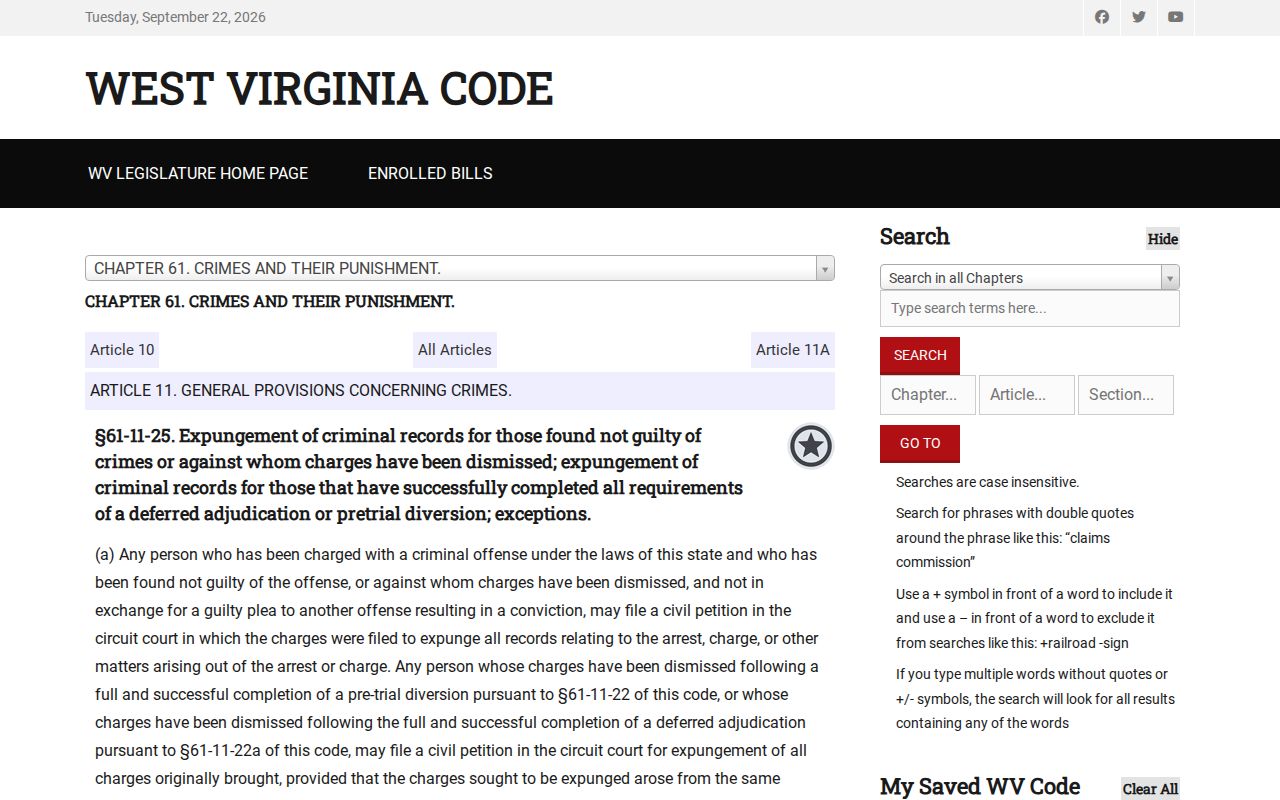
Eligibility turns on the case outcome and the statutory terms. Check the petition and order, not assumptions.
Note: A dismissal may support a petition, but the court order itself must be confirmed before treating agency records as expunged.
West Virginia Arrest Record Court Petition
Clearing a conviction takes a separate path under §61-11-26. That statute covers certain misdemeanors and nonviolent felonies. Offense exclusions apply, along with waiting periods. Applicants must also finish any incarceration and supervision first. From there, the petition is served on the officials and institutions the statute names, and interested parties get a chance to object before the court applies the legal standard. A grant seals the court record and directs agencies to expunge qualifying records, with law enforcement keeping limited access.
Start with the circuit clerk in the county of arrest. Pair that visit with the current West Virginia Judiciary expungement forms and instructions, which walk through the official court route step by step.
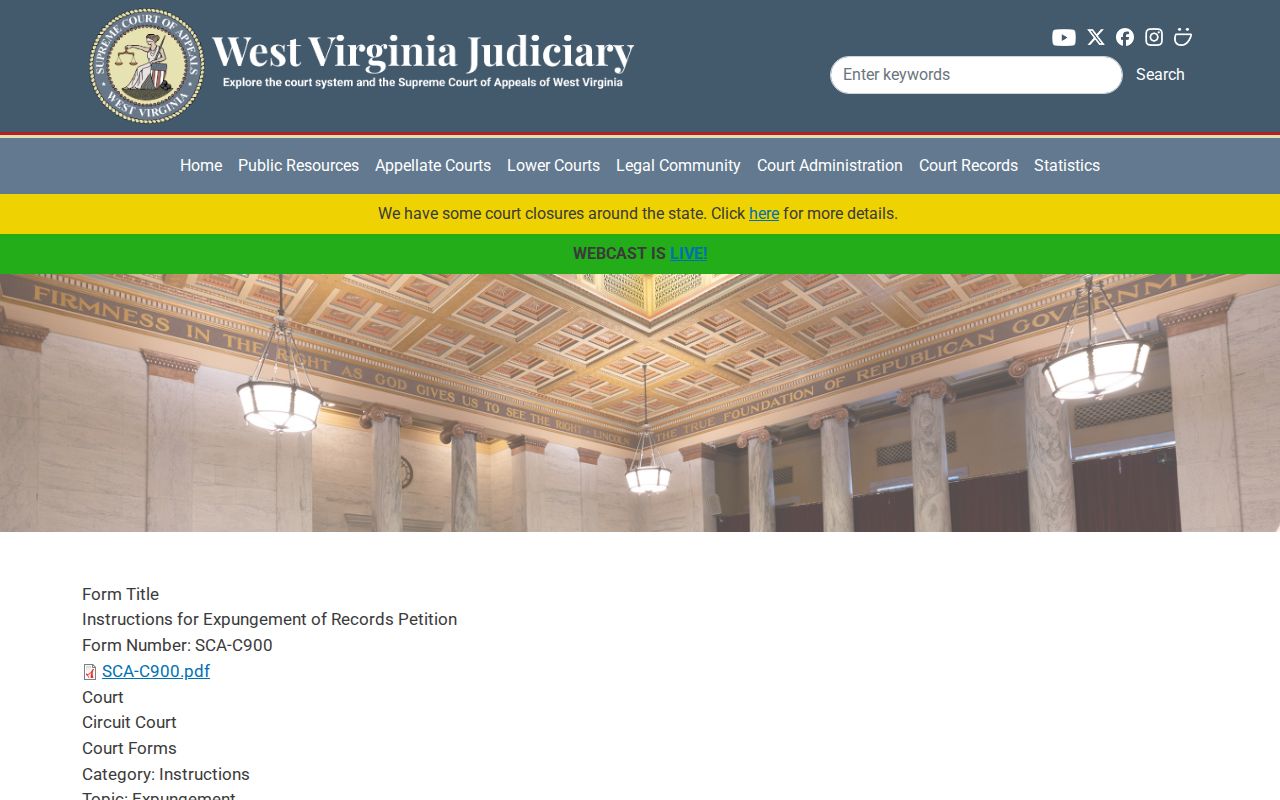
Filing the empty form only opens the case. Everything hinges on a qualifying court order.
The West Virginia State Police Criminal Records instructions point petitioners to the circuit court. That is the court in the county of arrest. Once an order is complete, WVSP mails a certified letter to the clerk. Its page also warns on one point. Do not call to check expungement status. Rely on the clerk and the court's current instructions for the case.
A granted order works on government records within its scope. It cannot force a news outlet, an independent publisher, or a social-media user to erase a separate copy. Nor can it compel a search engine. Send the order to each source. That source may hold a stale version. If an old search result lingers, use the engine's current outdated-content process. Deletion is never guaranteed across the board.
West Virginia Retention Is Not Posting
Retention schedules tell public offices how long to keep certain record series. Keeping a record is not the same as posting it. Nor do schedules promise that a photograph survives as long as its booking entry. The State Archives' sheriff schedule sets a five-year retention period for commitment records before destruction. Jail records or boarding reports are kept five years after the relevant audit. A prisoners report carries a ten-year-or-audit term. Fingerprint records stay on file as long as they hold value, then are destroyed.
Booking photos do not all share one retention term. An image may sit in an identification, jail, law-enforcement, or electronic system. A separate policy or legal hold may govern it. Name the specific photo in any request. Ask the custodian which schedule or authority applies. An old image that cannot be found does not prove it was never made.
Note: A retention term applies to its listed record series, not automatically to a booking photo, social post, or search-engine result.
Independent Copies and Corrections
Spot an error in an online record? Start by identifying who created that copy and what event it describes. Write down the page address and the disputed field. Note the last update shown and the record's legal status. Then contact the originating agency or court custodian. Ask for an official correction. If the error sits with an independent publisher, contact that publisher too. A corrected agency record helps. It will not automatically refresh every copied page or search result.
Some secondary publishers say they accept qualifying correction or removal requests free of charge. RecentlyBooked's removal policy describes one such free route on its own policy page. Those are publisher rules, not West Virginia law. Terms can change, and each publisher decides how its policy applies. No publisher's claim promises removal of an accurate, public, or independently copied record.
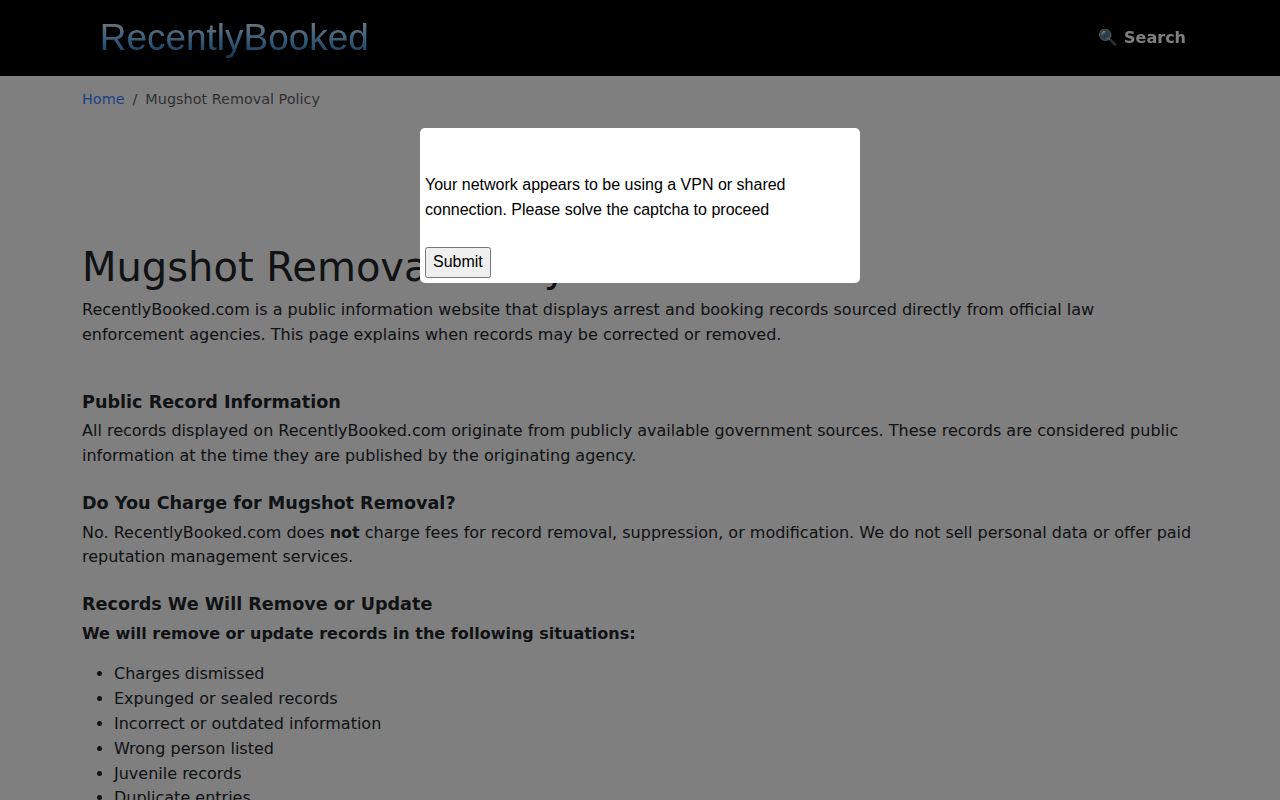
Note: that publisher's policy page states only what one site will review, not a statewide right to removal.
| Source | What to verify |
|---|---|
| Arresting agency or jail | Booking facts, custody status, the agency's own photo, and the stated correction route. |
| Court clerk or case portal | Filed charge, case number, hearing entries, and final disposition. |
| Independent publisher | Its own correction policy, copy date, and whether a no-charge route applies to the circumstances. |
| Search engine | Whether a result still points to a changed or removed source page and what refresh request is available. |
For a qualifying dismissal, acquittal, or conviction, the court route comes first. Use §61-11-25 or §61-11-26. Then ask each independent source to refresh its own copy. Juvenile, sealed, or protected matters work differently. Do not repost a third-party page to challenge it. Bring the issue to the custodian or to counsel instead. The law reaches government records, while independent copies stay a separate correction problem.
Where West Virginia Arrest Records Appear
A current booking question starts with the arresting or holding agency. Ask its official roster or records unit. A court outcome question goes to the court record or the circuit clerk. For state corrections custody, use the WVDCR search layer. That layer is not the county booking record. The statewide West Virginia arrest source map lays out how those official channels differ. It also flags where a county-specific feed exists. The West Virginia State Police page covers press releases and report requests, not a daily statewide jail roster.
Court entries answer a case question. They do not replace a jail's live custody data.
News stories and secondary booking pages can add context. Yet they may be selective, stale, or incomplete. Always check an official source first and label any publisher as secondary. The same care applies once a record has been sealed, expunged, or corrected.
Note: Source review is dated September 22, 2026; statutes, court forms, retention schedules, and private publisher policies can change.