
West Virginia Arrest Logs Over Several Days
No single statewide ledger collects every West Virginia arrest. Sheriffs and city police departments may post local blotters. The West Virginia State Police publishes only selected releases. The corrections division offers date-based jail admissions, and newsrooms cover the events they choose. These channels overlap now and then, but each has a different publisher and a different purpose. A weekly arrest log search spans several days, so it can catch names a same-day check missed. It is not a promise that any source keeps seven days online. A quiet page does not mean no arrest happened.
Where you start depends on your question. The arresting agency holds the incident or release record. A jail source shows an admission. A court source covers later case events. An agency release, a booking entry, and a news story are different kinds of records with different limits. Counties also differ widely in what they publish. Some point to regional custody systems, some post press items, and many offer no predictable public blotter at all. The county's own public page is the best place to confirm whether a current link or an archive exists.
| Channel | Typical scope | What it does not establish |
|---|---|---|
| County sheriff or police page | Local blotter, press release, or a link to a jail vendor when one is documented. | There is no shared county window, photo rule, or posting schedule. |
| WVSP News | Dated state police releases about selected events and enforcement work. | It is not a daily roster or a full dispatch log. |
| WVDCR Daily Incarcerations | Date- and institution-based jail admission lookup. | It is not a deep archive of every arrest or a statewide blotter. |
| Newsroom archive | Selected arrest, investigation, court, and public-safety stories. | Stories are not a complete booking list and may not show later outcomes. |
| Private booking archive | Publisher-controlled date, county, charge, and photo pages where available. | It is secondary and can be stale, incomplete, or wrong. |
What an Arrest-Log Entry Shows
No standard format governs these entries. A short sheriff release may list only an incident date and a brief account. A booking vendor shows custody fields. A news story may add quotes or context. The kinds of fields vary by source, so treat any list of them as possible rather than guaranteed.
| Entry field | What it can tell you | Read with care |
|---|---|---|
| Publisher and post date | Which agency, jail, newsroom, or service made the entry and when it appeared. | Post date may differ from the incident or booking date. |
| Incident or booking date | When the event was reported or custody was recorded. | These dates describe different steps and may not match. |
| Agency, county, or facility | Where the report originated or where custody was recorded. | A regional jail label does not identify every arresting agency. |
| Charge or narrative | The charge or a short description of the reported event. | Charges can change; a release is not a court finding. |
| Image or later update | A photo when the source publishes one, or a correction or case update. | Photo rules vary, and an old page may not reflect a later outcome. |
Keep each source's original date and title. A booking number can help a custodian locate a file, while an article link may lead to a story edited after publication. Names, charges, or timing sometimes differ between sources. When they do, ask the source holder to clarify rather than picking the most striking version.
West Virginia County Blotter Variation
The 55 county files show real variety. No two counties publish arrests the same way. One links to a regional jail roster. Another leans on an outside booking vendor. A sheriff posts short press releases, while a municipal department lists its own incident items. Some counties offer no stable public log at all, same-day or multi-day.
So treat each county on its own terms. A roster is not a blotter. A blotter is not a full booking index. A current-custody page can drop a name after a transfer or release, and an agency news page only announces what it chooses. A local government may also swap a menu or vendor while the same office keeps the underlying arrest record.
Start with the County Directory. Open the sheriff, police, or regional-jail links that county publishes. If no blotter is listed, skip the commercial lookalikes. Ask the arresting agency directly which office holds the report, and whether any public arrest log exists at all.
Note: A county page may change its vendor or menu, so confirm a saved arrest-log link from the county's current official site.
WVSP News Is Event-Driven
WVSP's News hub is a dated stream of releases. It is not a daily statewide roster. It is not a full dispatch log. A release may describe a public-safety event, an investigation, an enforcement effort, or an arrest the agency chooses to announce. Its date and narrative fit that event. The page does not list every arrest by troop, county, or day.
Traffic Safety material adds enforcement and safety context. A program page or a results release can explain a focused operation. Neither substitutes for a county booking record. Someone arrested by WVSP is booked into a county jail or regional facility. The custody entry and the agency's own report can live in separate systems.
WVSP's News page shows the agency's dated release stream and its selective scope. The agency's Traffic Safety section provides another official view of targeted enforcement and safety work.
For an arrest report, contact the agency that made the arrest. Use the facility or county route for jail admissions. An announcement alone is not a custody record.
News Reports and Secondary Archives
A news archive often outlives an online booking table in West Virginia. WV MetroNews reports events statewide. WV News adds statewide and regional coverage. Either one may carry a story about an arrest, a charge, a hearing, or a later development. Stories select events, though. They are narratives, not rosters, and no headline settles a case.
News stories stay online as a record of what was reported at the time. So look to the court or agency record for the current status of any case. Private publishers add another layer of West Virginia arrest archive pages. Busted Newspaper's West Virginia section holds a deeper archive. It covers booking dates, county labels, charges, descriptors, and photos. RecentlyBooked's state section claims a short recent window with frequent refreshes. Arrests.org's West Virginia pages offer filters and archive-style navigation. These are secondary publishers. Each one controls its own access, accuracy, photo policy, and correction speed. None serves as an official county blotter.
Start with the official source. Treat every secondary copy as a lead that still needs checking. A private archive can keep a photo or charge long after an agency page changes. It may still miss a dismissal, correction, transfer, or release. No aggregator's archive is complete, current, or endorsed by a government office. For a correction, contact the publisher and the original custodian. Include the exact record and supporting disposition. No removal result is ever promised.
Note: A news archive selects events for coverage and does not show the unreported bookings between published stories.
Weekend and Holiday Arrest Patterns
People get arrested at all hours. Posting follows each source's own habits instead. West Virginia official sources set no single weekend or holiday rule. One vendor updates during the day, another agency batches a weekend roundup, and some pages show nothing new until the next workday. That spread makes a multi-day check worthwhile. It still does not make any one report complete.
A Monday story may describe a Saturday arrest. A jail entry can appear on a different timeline. It may differ from a police release. Keep the event date and the posting date as separate facts. Comparing one source's weekend total against another's weekday-only list will only mislead. The 24 Hour Arrests page explains how to read a dated admissions view. It also shows how to confirm a fresh booking. County, agency, and news sources each answer different record questions. None posts every day.
How to Read a West Virginia Blotter
Read the source before the charge. A multi-day page can mix arrests, incident reports, court announcements, and agency news. So the label at the top matters more than a search snippet. Work through each entry in order and see what it can actually support. A blotter is simply the short event list. It shows what an agency or publisher chooses to share. It is not a full court file. Disposition is the court's action in a case, such as dismissal or conviction.
- Note the publisher and date range. Determine whether the entry comes from a sheriff, police department, jail system, state agency, newsroom, or private publisher. Write down both the event date and the post date when shown.
- Separate incident from booking. An arrest report describes an agency event; an admission record describes custody at a facility. One may exist before the other appears online.
- Read the field labels and source terms. “Charge,” “arrested,” “booked,” and “released” refer to distinct steps. Do not treat a vendor label as a court disposition or a publisher's photo as an official roster result.
- Check an official record for status. Use the arresting agency or custodian for the underlying report, and the relevant court source for a later case event. Ask for a correction if the public entry has the wrong person, date, or charge.
- Use the wider state overview for routing. The West Virginia recent-arrests hub explains the broader path among county records, jail custody, and court sources.
Blotter charges come from an early stage. They can change later. An entry that shows no result does not mean the first claim was upheld. Check the court record for what a charge became.
West Virginia Arrest Record Archives
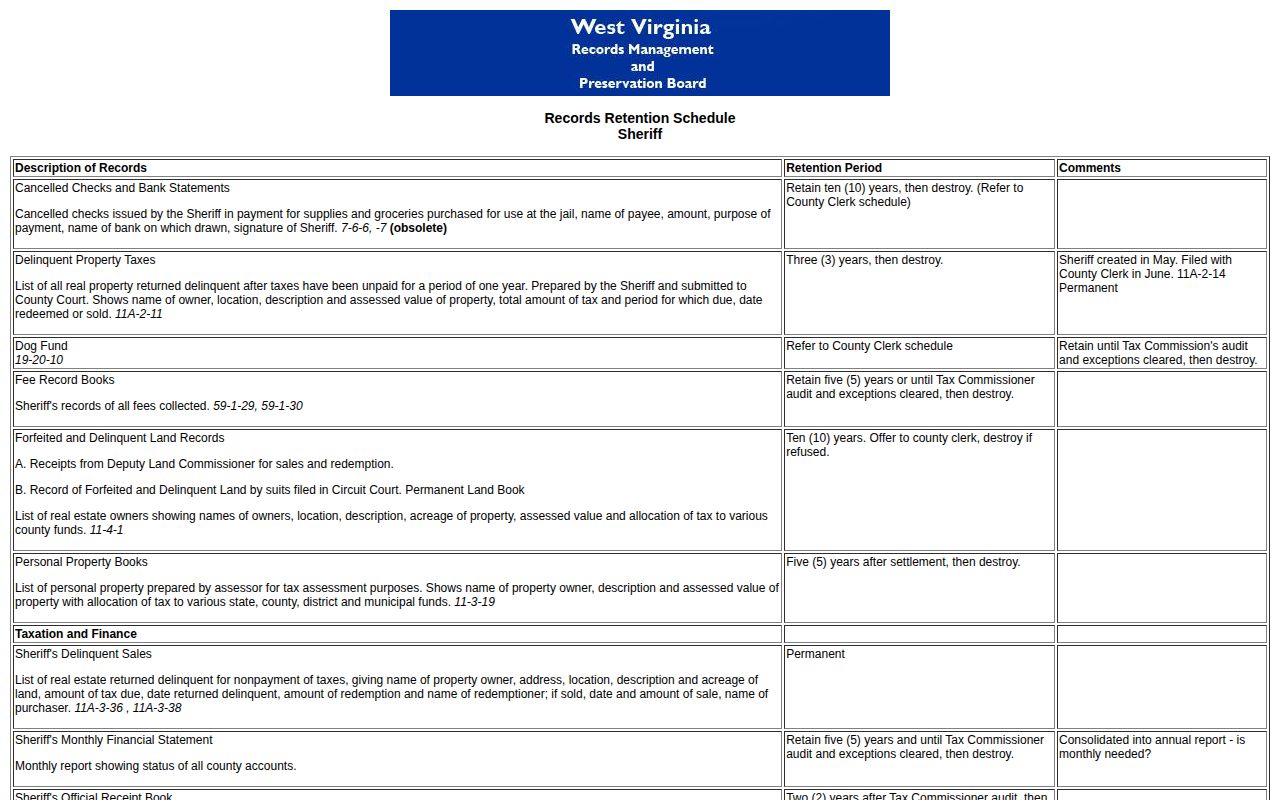
A posting window and a retention period are different things. A page may drop an old entry. The underlying report sits in an agency file. Or a record may have been lawfully destroyed under a schedule. The State Archives' county retention schedules explain the record series. No schedule promises that a booking photo stays online or in one public database.
The sheriff schedule lists a commitment record kept five years before destruction. Jail or boarding reports are held five years after the relevant audit. A prisoners report runs ten years or until audit. Fingerprint records follow a different rule. They may be kept as long as valuable, then destroyed. Each line covers one record series. No single term governs every arrest log or image. Ask the custodian for the specific series and retention authority. The Sheriff records-retention schedule is the official reference.
Older custody research points elsewhere. The West Virginia Archives corrections collections describe institutional records, finding aids, and access limits. Collection AR-1804 spans roughly 1935 to 1953. AR-1861 holds reform-school materials from about 1900 to 1945. These are historical collections, not a searchable set of current booking photos. Privacy rules still apply.
Every record has a home. The custodian is the agency that holds it. When an online arrest log runs dry, that office is the place to ask. West Virginia Code §29B-1-3 gives the custodian five days, not counting weekends and legal holidays, to hand over the record, schedule an inspection, or issue a written denial. Fees can cover copying costs only. Searching and staff time cannot be billed. A good request names the agency, the county, the approximate date, a report number if you have one, and the exact record you want. Keep in mind that §29B-1-4 exemptions can still shield juvenile files, active investigations, and private information.
Note: Retention schedules govern record series and disposition; they do not make every old booking image available online.